
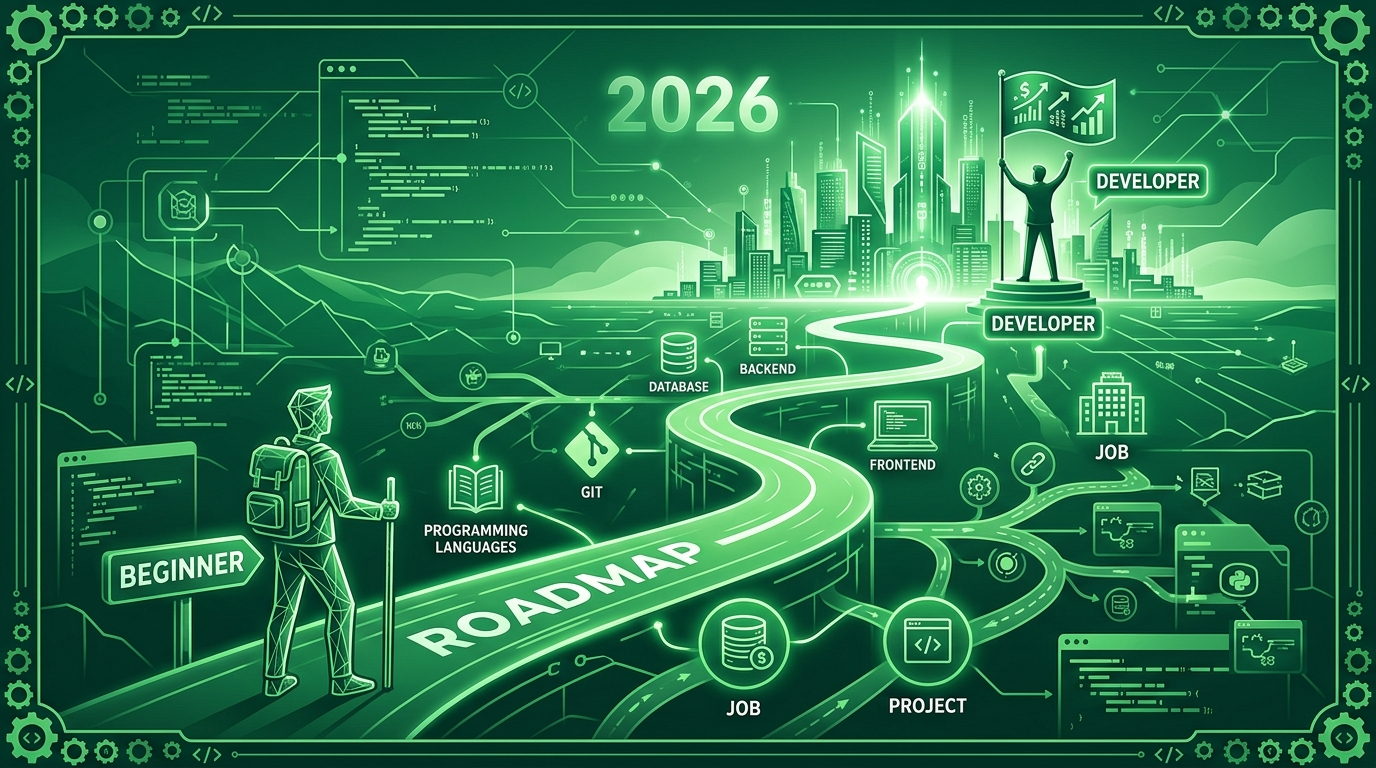

Familior problem
Many people start learning programming languages altogether without any defined strategy and vision for it and they reach nowhere just because they are jumping here and there, today learning html and tomorrow css and tomorrow evening may be listening to javascript tutorials which make them confused so much that they leave all at once. Because learning already built code is easy but finding and bug and resolving it is a big mess which without predefined strategy of learning and practicing your cannot reach your goal and being frusterated you will leave everyhting. Sound familiar?
Here's the hard truth: you cannot learn everything at once and sure, you don't need to do it now. What you need is a focused, strategic plan that prioritizes what actually matters for getting hired.
My Strategy – Start from the Back
Most beginners want to build websites right away. They start with HTML and CSS because it's visual and rewarding. But this is a mistake.
I should say that start with back-end development first instead of frontend. Why because when you understand what's happening behind the scenes—how data flows, how authentication works, how servers process requests—the front-end stops being mysterious. You'll understand why APIs are structured the way they are. You'll know exactly where data comes from and where it's going.
On the other hand, if you start with front-end, the back-end will always feel like black magic. You'll copy-paste code without truly understanding it. And that's a dangerous place to be.
So trust me on this one. Build your foundation from the back-end.
The 11-Month Game Plan
Here is exactly what you need to learn, in order, with realistic timeframes.
First, spend two months learning a programming language. This is your foundation. Everything else builds on this.
Next, dedicate two weeks to Git and version control. This might seem small, but it's absolutely essential for working with teams.
Then, invest two months in data structures and algorithms. This is what separates serious developers from hobbyists. Most self-taught developers skip this, and it shows in interviews.
After that, spend two months studying design patterns. These are proven solutions to common problems, and they're used everywhere in professional development.
Then, dedicate two months to databases. This is where your application's data lives, and you need to understand how to manage it properly.
Finally, spend two months learning a web framework. This is where you'll actually build real applications.
In total, that's about eleven months of focused study. No distractions. No shiny new technologies. Just the essentials.
Choosing Your Weapon – The Language Dilemma
Python, Java, JavaScript, C#, Ruby, Go—the options are overwhelming. And everyone has an opinion.
Here's my take: choose one language and commit to it completely.
If you're a complete beginner with no programming background, pick Python. It's clean, readable, and forgiving. You'll make progress faster and stay motivated.
If you're serious about computer science fundamentals and want to work in large enterprises, pick Java. It's taught in universities for a reason. Once you master Java, learning C#, C++, or JavaScript becomes significantly easier.
Don't spend weeks researching which language is "best." There is no best. There is only what works for your situation. Research job postings in your area, see what employers are asking for, and make a decision. Then stick with it.
What Most Candidates Ignore
Here are three areas that self-taught developers frequently skip—and it costs them dearly in interviews.
Data Structures & Algorithms
This is the elephant in the room. Most bootcamp graduates and self-taught developers avoid it because it feels academic and irrelevant. But tech companies test these concepts in interviews. Every. Single. Time.
You need to understand Big O notation, which measures how efficient your code is. You need to know arrays, linked lists, stacks, queues, and hash tables. You should understand trees, graphs, and how to traverse them. Sorting algorithms like merge sort and quick sort are essential. Searching algorithms like binary search will come up repeatedly. And recursion is a concept that unlocks many complex problems.
Spend two months here. It will transform how you think about problems.
Design Patterns
There are 23 classic design patterns documented in the Gang of Four book. You don't need to memorize all of them. But you absolutely need to understand the most common ones.
The singleton pattern ensures a class has only one instance. The factory method creates objects without specifying the exact class. The observer pattern implements publish-subscribe functionality. The strategy pattern lets you swap algorithms at runtime.
Why does this matter? Because frameworks like Spring, Django, and ASP.NET Core use these patterns heavily. Understanding them gives you insight into how these frameworks work under the hood.
Git
I'm always surprised how many developers neglect version control. Git isn't optional. It's how teams collaborate.
You need to know basic commands like init, add, commit, push, and pull. Branching and merging are essential skills for working on features independently. Resolving conflicts is something you'll do frequently on real projects. And pull requests with code reviews on GitHub are how professional teams work.
Two weeks is enough. Don't skip this.
Databases – Where Data Lives
Every application needs to store data. You need to understand both relational and NoSQL databases.
Start with MySQL. It's open-source, widely used, and beginner-friendly. It gives you a solid foundation in relational database concepts.
Learn how to write SELECT queries with various conditions. Understand joins—inner joins, outer joins, and self joins. Master aggregate functions like COUNT, SUM, and AVG. Subqueries and views are important tools. And database design with primary and foreign keys is fundamental.
After MySQL, consider exploring MongoDB for NoSQL. It stores data without a predefined structure, which offers flexibility. But honestly, for many entry-level jobs, MongoDB isn't required. Focus on getting solid with MySQL first.
Your First Web Framework
Once you know a language and understand databases, it's time to learn a web framework. This is where you'll actually build applications.
Your framework choice depends on your language. Python developers typically choose Django or Flask. Java developers go with Spring Boot. JavaScript developers use Express.js. And C# developers work with ASP.NET Core.
Django is excellent for rapid development. It comes with everything built-in—authentication, admin interface, ORM. Spring Boot is more complex but powerful for enterprise applications. Express.js is lightweight and flexible.
Don't try to learn multiple frameworks. Master one.
Coming to the Front-End
After about eleven months of back-end work, you're finally ready for the front-end. Here's the breakdown.
HTML takes about two weeks. Learn semantic tags, forms, tables, and multimedia elements.
CSS takes about one month. Master flexbox, grid, and responsive design with media queries.
JavaScript takes two full months. Don't rush this. Learn DOM manipulation, asynchronous programming with promises and async/await, the fetch API, event handling, and browser storage.
TypeScript takes about three weeks. It adds static typing to JavaScript and is increasingly required in job postings. Learn interfaces, classes, generics, and utility types.
React takes about two months. Learn components, props, state, and hooks like useState and useEffect. Understand state management with Context API or Redux. Routing with React Router is essential.
Automated testing takes about one month. Learn Jest and React Testing Library. Many candidates skip testing, but it's a huge plus in interviews.
SASS takes about two weeks. It's a CSS preprocessor that makes styling more manageable with variables, nesting, and mixins.
Tailwind CSS takes about three weeks. It's a utility-first framework that speeds up development with predefined classes.
Next.js takes about one and a half months. It's a React framework with server-side rendering and static generation. It's what modern companies are using.
Build Projects That Actually Matter
This is non-negotiable. You cannot learn by watching tutorials alone. You must build.
Start small and progressively increase complexity.
Beginner projects include a calculator, number guessing game, unit converter, and password generator. These help you practice functions, control flow, and user input.
Intermediate projects include a to-do list application, weather app, quiz app, and contact book. These introduce data structures, API integration, and more complex logic.
Advanced projects include a blog API with authentication, e-commerce storefront, expense tracker, social media API, and job board API. These demonstrate your ability to build full-featured applications.
Your GitHub portfolio should have three or four solid projects that demonstrate your skills. This is more valuable than any certificate.
Skills That Take You to Senior Level
Once you have the basics down, these skills will help you advance to senior roles.
Database optimization includes query tuning, indexing, and sharding. API design covers RESTful principles and GraphQL. Security involves OAuth, JWT, and preventing SQL injection and XSS attacks.
Scalability includes load balancing, caching with Redis, and message queues. System design covers microservices, event-driven architecture, and domain-driven design.
DevOps includes Docker, Kubernetes, and CI/CD pipelines. Cloud computing involves AWS, Azure, or Google Cloud.
Don't worry about these in your first year. But keep them on your radar for when you're ready to level up.
Final Thoughts
The journey from beginner to employable developer takes about twelve to eighteen months of consistent effort. There's no shortcut. But there's also no mystery.
The developers who succeed aren't necessarily the most talented. They're the ones who stayed consistent when things got difficult. They built projects instead of just watching tutorials. They focused on fundamentals instead of chasing shiny new technologies.
Follow this roadmap. Commit to the timeline. Build real projects. And when you're ready, apply with confidence.
What's your biggest challenge right now? Let me know in the comments.
Sign in to join the conversation and share your thoughts.
Log In to Comment